
Remote & isolated operations

Clinical expertise for places beyond the clinic.

Offshore platforms, energy and mining sites, border posts and other isolated operations depend on a small local team. A LifeBot encounter combines that team’s observations with selected monitoring, ECG, examination media and remote consultation.

  • Offshore and energy operations
  • Mining and construction sites
  • Border and remote posts
  • Expedition and research sites
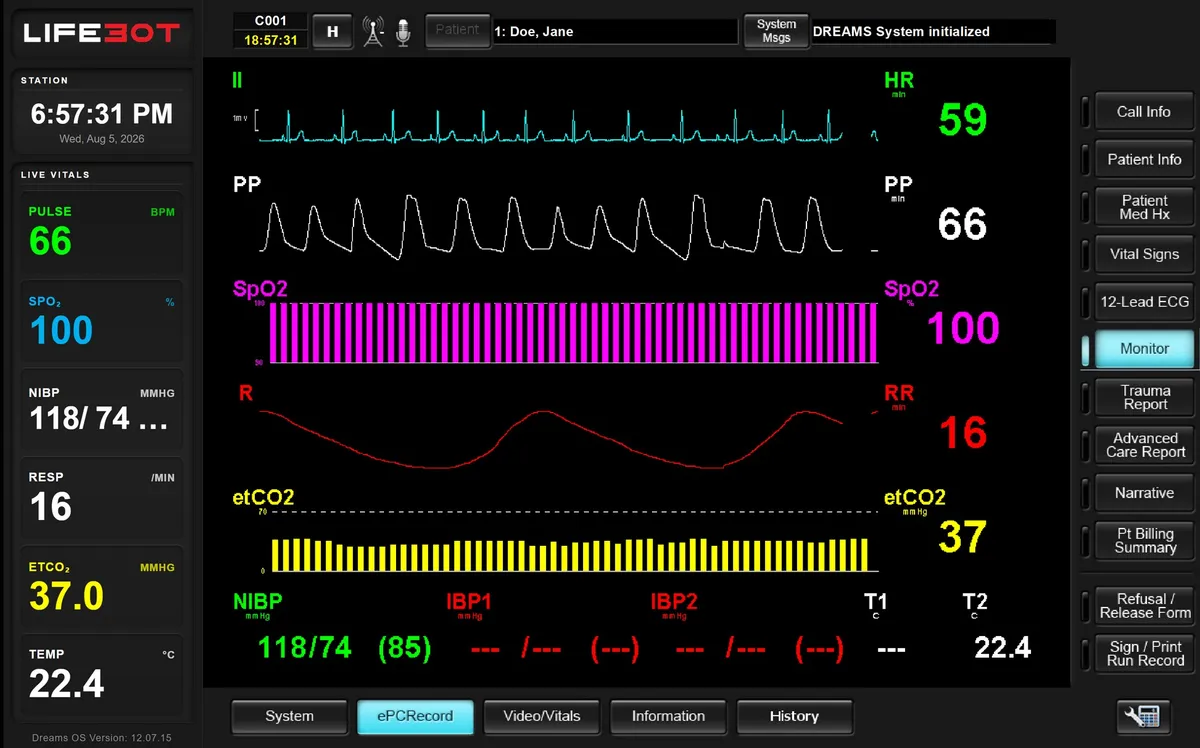
Patient-side monitoring with waveforms and measurements
Patient-side monitoring: waveforms, numeric measurements and encounter navigation. Demonstration view · sample data. Historical screen labels do not verify a current installation.

The operational problem

Distance makes the right information especially valuable

With limited local capability, the remote practitioner depends entirely on what the local team can capture and share.

The design covers local care capability, escalation, remote clinical coverage, power, equipment support and the communications services available at the site.

How the network fits

Each participant gets a defined role.

The configuration assigns a workspace to each role. Equipment, communications and interfaces follow the selected design.

Planning the service

Questions we answer together before any proposal.

A configuration that fits the mission covers the clinical task and everything that keeps it running.

Operating conditionPlanning response
Local capabilityWho provides direct care and what equipment they need.
EscalationWho provides consultation, and the alternate contact method.
ConnectivityAvailable satellite, cellular and site services.
SustainmentPower, consumables, spares, training and support.

In your demo

What we will show you.

  • A site-medic encounter with monitoring and digital auscultation
  • Consultation over a constrained connection profile
  • Local work during interruption and later record receipt

LifeBot systems are not yet registered for clinical use in Türkiye. Until registration is complete, they are presented for demonstration and evaluation with sample data.

Who should join

  • Health, safety and medical lead
  • Site operations
  • IT and communications
Request a demo

Relevant evidence

What the record shows, and its limits.

All evidence

2024–2025

NASA ground-based medical research

NASA researchers included LifeBot 10 in work on multifunctional integrated medical devices and Earth-independent medical operations, including an Exploration Atmospheres ground study.

What it shows
Device capabilities, user experience, atmosphere exposure and integration limitations studied in a constrained-environment research context.
What it does not show
Ground research only. No NASA endorsement, no current-product validation and no operational space deployment is implied.

Source: NASA HRP Investigators’ Workshop presentations, 2024 and 2025.

2005

Hurricane response, New Orleans and Texas

A Liberty County EMS DREAMS ambulance deployed to New Orleans after Hurricane Katrina; a transportable station supported evacuee care in Nacogdoches with remote clinical support from Memorial Hermann, Houston. After Hurricane Rita, a station supported a temporary clinic in Rye, Texas, for about a week.

What it shows
Deployment of connected clinical equipment into a disrupted care environment, relying on cellular communications where the public network was unavailable.
What it does not show
Original programme equipment and dates. Not a specification for a current LifeBot product.

Source: Digital EMS final report, 2006 (pp. 46–47).

Request a demo

See the complete encounter, live.

Book a demonstration with sample data: patient-side work, the remote clinician joining, local work during an outage and the record arriving. Online, on site in Türkiye or at ICMM 2026.

Request a demo