
Defence & deployed medicine

The forward team has the patient. The specialist is somewhere else.

A deployed medical service connects responders, transport teams, treatment locations and remote specialists. The LifeBot Medical Command Network gives each of them a defined role, organised around the care pathway and the people responsible for it.

  • Armed forces medical services
  • Gendarmerie and border units
  • Field and role hospitals
  • Protected-mobility medical vehicles
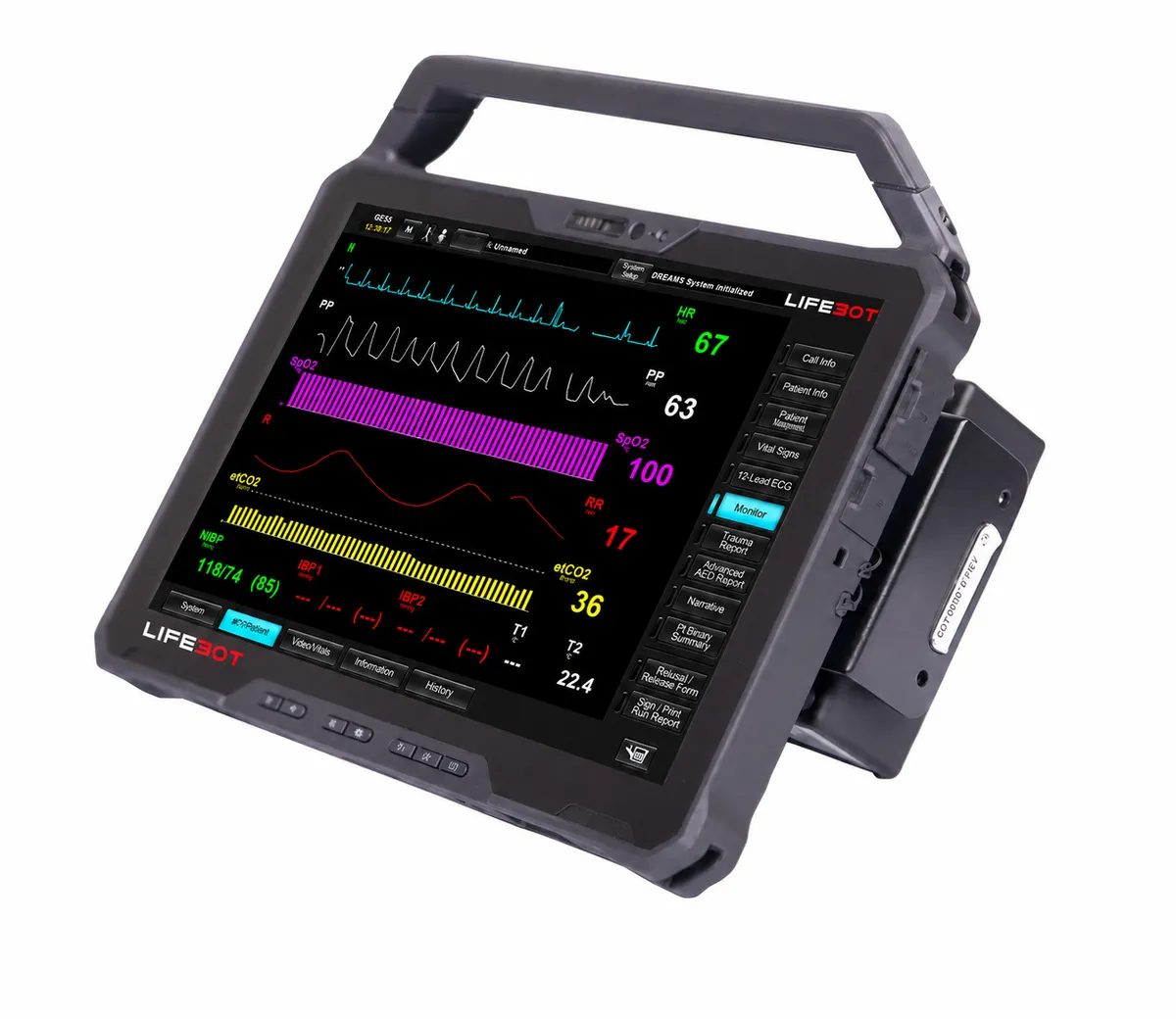
LifeBot Link rugged tablet with clinical monitoring display
Product-family illustration. Pictured equipment and arrangement are configuration examples.

The operational problem

Movement, finite power and intermittent remote access shape the service

Forward care happens at changing locations, often far from the clinician who could help. The medical plan has to give the local team a useful patient-side workspace and define exactly how consultation and record handoff occur.

Planning priorities include the clinical equipment, who provides remote coverage, communications during movement, power, transport, training and replenishment.

Planning the service

Questions we answer together before any proposal.

A configuration that fits the mission covers the clinical task and everything that keeps it running.

Operating conditionPlanning response
Dispersed personnelDefine consultation coverage and the participating clinical roles.
Changing locationsPlan carrying, mounting, power and the site or vehicle network.
Interrupted remote accessContinue the local workflow and use the agreed alternate contact process.
Care transitionPrepare documentation and agree the receiving team’s handoff.
Extended operationPlan charging, consumables, spares, maintenance and shift familiarisation.

In your demo

What we will show you.

  • A forward encounter on Link with monitoring and ECG
  • A remote clinician joining through Command
  • Local documentation continuing while the remote link is unavailable
  • The record package located in Matrix afterwards

LifeBot systems are not yet registered for clinical use in Türkiye. Until registration is complete, they are presented for demonstration and evaluation with sample data.

Who should join

  • Medical operations lead
  • Communications / C4I officer
  • Logistics and procurement
Request a demo

Relevant evidence

What the record shows, and its limits.

All evidence

1998–2006

DREAMS research programme

Texas A&M engineering with UTHealth Houston clinical participation; U.S. Army Medical Research and Development Command identified as programme sponsor.

What it shows
The origin of the clinical software: ambulances and deployable stations connected with hospital physicians through video, audio and patient physiological information.
What it does not show
Earlier programme lineage. It is not proof of today’s full Medical Command Network configuration.

Source: Digital EMS reports (1999–2006); Texas A&M programme page.

Original DREAMS programme

Military ambulance testbed (M997A2)

Integration of medical communications equipment into an existing military ambulance.

What it shows
How stowage, mounting, wiring, power, thermal arrangements and camera placement were addressed without compromising the vehicle’s care and transport role.
What it does not show
Counts, dimensions and communications arrangements belong to the original programme, not to a current product.

Source: Digital EMS final report, 2006 (pp. 29–35).

Request a demo

See the complete encounter, live.

Book a demonstration with sample data: patient-side work, the remote clinician joining, local work during an outage and the record arriving. Online, on site in Türkiye or at ICMM 2026.

Request a demo