
112 & pre-hospital care

Bring the specialist into the ambulance.

Emergency medical services cover long distances and time-critical conditions. LifeBot lets the crew document the encounter, share selected monitoring, ECG and media, and bring a remote physician or specialist into the case before arrival.

  • Emergency ambulance services
  • Mobile stroke and specialist units
  • Air and rural ambulance operations
  • Emergency departments receiving patients
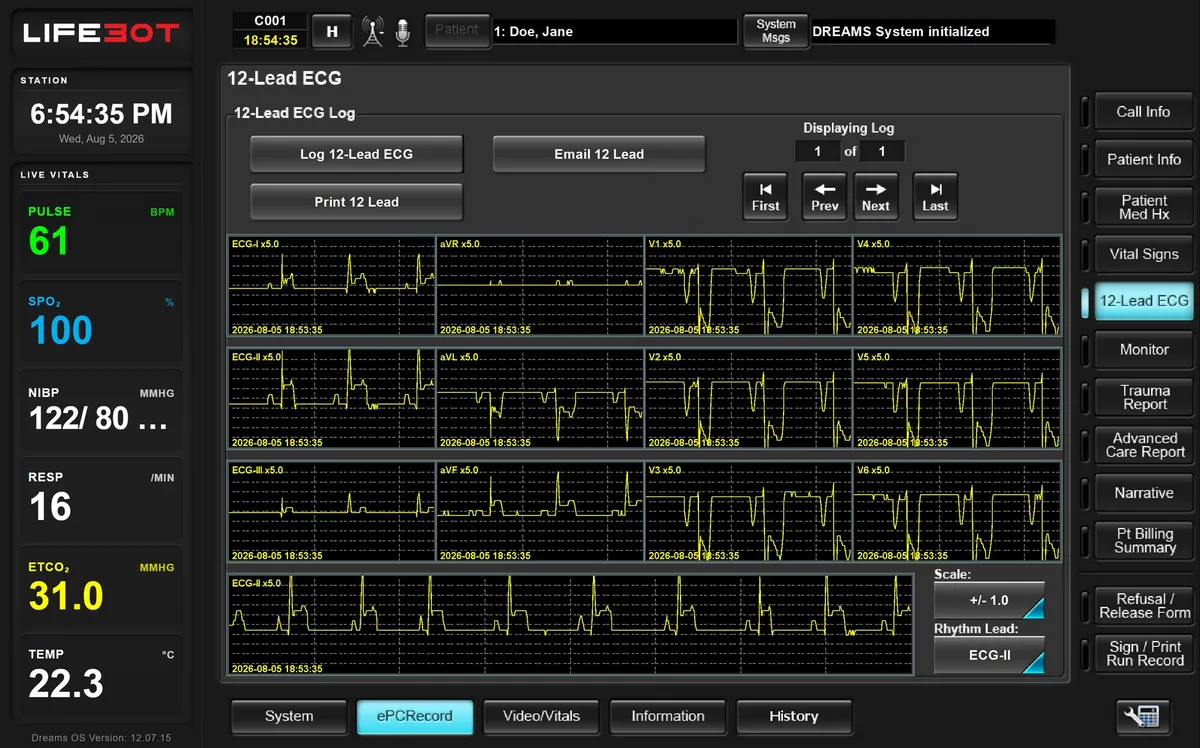
Twelve-lead ECG review workspace
Twelve-lead ECG review with lead panels and record navigation. Demonstration view · sample data. Historical screen labels do not verify a current installation.

The operational problem

Distance turns minutes into decisions

In rural regions and long transfers, the crew may need specialist input long before the patient reaches hospital. The remote clinician needs the right context to help.

Start with the information the remote clinician needs and the personnel who acquire it, then define how the consultation fits the transport workflow and what the next care team receives.

Planning the service

Questions we answer together before any proposal.

A configuration that fits the mission covers the clinical task and everything that keeps it running.

Operating conditionPlanning response
Information at the patientWhat will the crew acquire and document?
Remote clinical roleWho reviews the case, and when are they available?
Service integrationHow do equipment, transport and consultation work together?
Record transitionWhat information does the next care team receive?

In your demo

What we will show you.

  • Call and patient context on the crew’s workspace
  • Monitoring and 12-lead ECG shared with a remote physician
  • Scene video with camera control and telestration
  • Run record output and receipt

LifeBot systems are not yet registered for clinical use in Türkiye. Until registration is complete, they are presented for demonstration and evaluation with sample data.

Who should join

  • Medical director
  • EMS operations
  • Receiving emergency department
Request a demo

Relevant evidence

What the record shows, and its limits.

All evidence

Introduced 2017 · published 2018

University of Alberta mobile stroke unit

A mobile stroke unit combining a CT scanner, point-of-care laboratory and LifeBot telestroke equipment, connecting a specialist team and a remote neurologist with patients transferred from rural locations.

What it shows
LifeBot equipment working inside a complete mobile clinical service, with remote specialist participation during transport.
What it does not show
The complete service was evaluated; outcomes do not isolate the equipment’s effect.

Source: Shuaib et al., BMJ Innovations 4, 54–59 (2018). DOI 10.1136/bmjinnov-2017-000240.

1998–2006

DREAMS research programme

Texas A&M engineering with UTHealth Houston clinical participation; U.S. Army Medical Research and Development Command identified as programme sponsor.

What it shows
The origin of the clinical software: ambulances and deployable stations connected with hospital physicians through video, audio and patient physiological information.
What it does not show
Earlier programme lineage. It is not proof of today’s full Medical Command Network configuration.

Source: Digital EMS reports (1999–2006); Texas A&M programme page.

Request a demo

See the complete encounter, live.

Book a demonstration with sample data: patient-side work, the remote clinician joining, local work during an outage and the record arriving. Online, on site in Türkiye or at ICMM 2026.

Request a demo