
Disaster & emergency response

When infrastructure fails, the clinical picture still has to travel.

A disaster response involves temporary treatment areas, dispersed teams and receiving facilities. LifeBot brings patient information, selected device views, media and documentation into one clinical environment that moves with the patient-side workflow.

  • National and provincial disaster response
  • Medical rescue teams
  • Temporary and field clinics
  • Receiving hospitals in affected regions
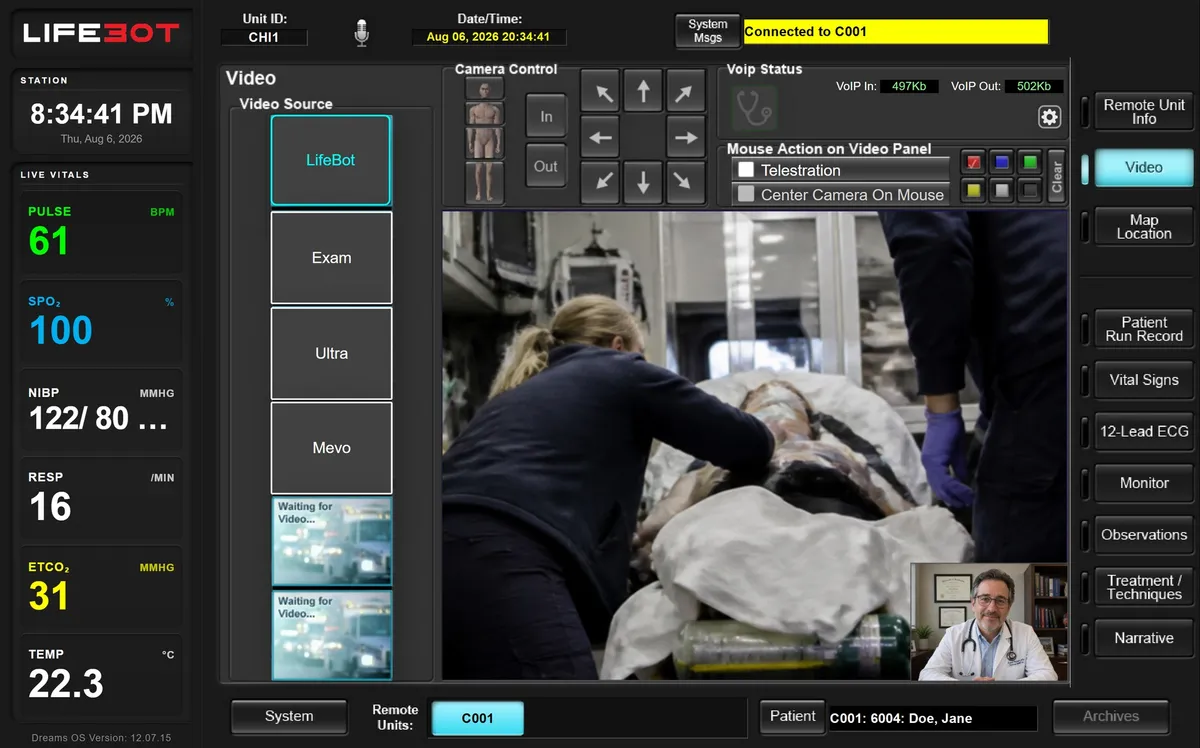
Command video workspace with scene camera, camera controls and live vitals
Command video workspace: selected scene, camera and telestration controls. A selected source, not proof of simultaneous independent feeds. Demonstration view · sample data. Historical screen labels do not verify a current installation.

The operational problem

Earthquakes and large-scale emergencies stretch every link in the chain

After a major earthquake, care is delivered in temporary locations by teams who may never have worked together, while public networks are degraded and specialists are far away.

The service design has to connect the first assessment with consultation, documentation and record handling, and choose communications and equipment to suit the locations and resources actually available.

Planning the service

Questions we answer together before any proposal.

A configuration that fits the mission covers the clinical task and everything that keeps it running.

Operating conditionPlanning response
Care at changing locationsDeployable Link and treatment-location Core workspaces.
Access to expertiseCommand consultation with the patient-side team.
Degraded networksICM path selection across the cellular, satellite or radio-IP services available.
Organised informationDREAMS documentation at the patient side and Matrix for received records.
Equipment and supportMedical Arsenal and accessory-pack selections, with replenishment planned.

In your demo

What we will show you.

  • Setting up a field encounter from a carrying case
  • Selecting the network path available at the scene
  • Continuing documentation during a simulated outage
  • Reconnection and locating the received record

LifeBot systems are not yet registered for clinical use in Türkiye. Until registration is complete, they are presented for demonstration and evaluation with sample data.

Who should join

  • Response planning lead
  • Field medical coordinator
  • Communications and IT
Request a demo

Relevant evidence

What the record shows, and its limits.

All evidence

2005

Hurricane response, New Orleans and Texas

A Liberty County EMS DREAMS ambulance deployed to New Orleans after Hurricane Katrina; a transportable station supported evacuee care in Nacogdoches with remote clinical support from Memorial Hermann, Houston. After Hurricane Rita, a station supported a temporary clinic in Rye, Texas, for about a week.

What it shows
Deployment of connected clinical equipment into a disrupted care environment, relying on cellular communications where the public network was unavailable.
What it does not show
Original programme equipment and dates. Not a specification for a current LifeBot product.

Source: Digital EMS final report, 2006 (pp. 46–47).

1998–2006

DREAMS research programme

Texas A&M engineering with UTHealth Houston clinical participation; U.S. Army Medical Research and Development Command identified as programme sponsor.

What it shows
The origin of the clinical software: ambulances and deployable stations connected with hospital physicians through video, audio and patient physiological information.
What it does not show
Earlier programme lineage. It is not proof of today’s full Medical Command Network configuration.

Source: Digital EMS reports (1999–2006); Texas A&M programme page.

Request a demo

See the complete encounter, live.

Book a demonstration with sample data: patient-side work, the remote clinician joining, local work during an outage and the record arriving. Online, on site in Türkiye or at ICMM 2026.

Request a demo